Indicator states on ATAS X
This page covers the Pulling & Stacking Indicator on ATAS X, where it runs as an indicator, in its own panel under the price chart.
The indicator does not present dead or unseeded output as signal. This is state display, not data filtering: the engine keeps reading the raw stream, and the display says what state the data is in.
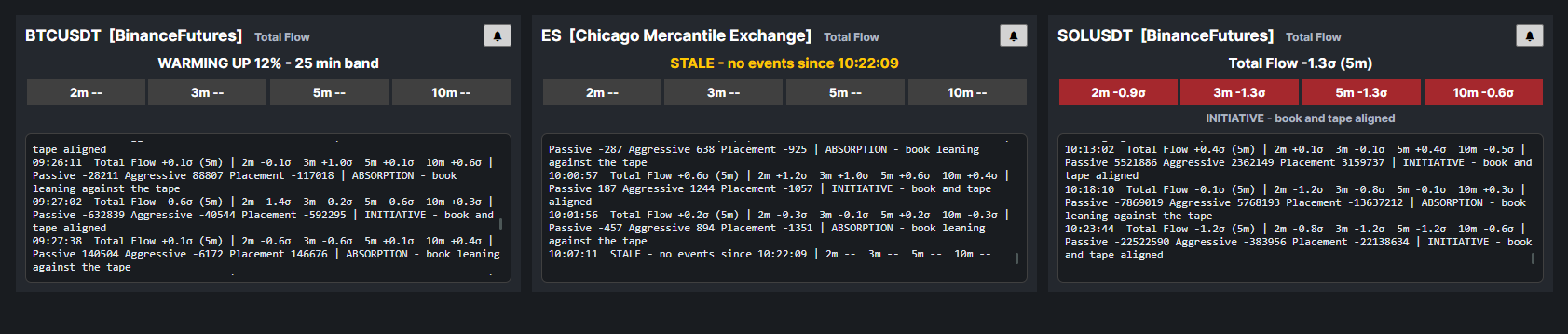
Warming up
The indicator comes up in stages, so you are not left waiting on a blank panel. With the default settings (5-minute primary window, 5× lookback):
| After | What you get |
|---|---|
| 5 min (one window) | The flow lines. Total, Passive and Aggressive Flow are exact once one full window has been seen. |
| 10 min | A fully seeded 2-minute reading in the headline, e.g. Total Flow +1.9σ (2m) - 5m band 40%, and a provisional band on the chart. |
| 15 min | The 3-minute reading takes over the headline. |
| 25 min | The primary band is fully seeded: Total Flow +4.2σ (5m). Alerts can fire. |
| 50 min | The 10-minute ladder cell is live. |
Provisional readings are estimates. Until a band has its full lookback it
rests on few independent samples and tends to be too narrow, so early σ values
read high. They are marked so you can tell: a ~ before the value
(5m ~+2.1σ), a muted badge colour in the console, and a dashed band on the
chart, which is drawn dotted once it is fully seeded. In ATAS's Drawing
settings each band has two entries: the band itself and the same band
"(provisional)". Provisional readings never trigger alerts.
Before the first stage the console shows progress:
WARMING UP 12% - 25 min band. Each window warms independently, so the
ladder fills in from left to right.
Ways to shorten the wait
- The indicator warms from live data. The order book has no history, so the lines start from the moment you add the indicator and the bars before it stay empty.
- Leave the platform running. The indicator loads with the platform and warms while you do something else.
- Most setting changes do not restart the warm-up. ATAS starts the indicator again whenever you apply its settings, and also when you open them and click Cancel; the indicator keeps its flow engine for the instrument across it: the warm-up, the lines already drawn, the arrows and the instrument's log in the console are all kept. It starts over if Depth or New Levels changes (a different measurement), or if nothing has fed it for a minute (the indicator was removed and added back later). Changing Lookback × re-warms the bands over the new lookback without touching the flow lines.
- A shorter Primary Window or S/R Lookback Multiplier warms faster, but changes what the readings mean; see calibrating the parameters.
Stale
A data stream that stops without notice can look like "flow went quiet", which reads as information when it is an outage. If no events arrive for the configured number of seconds (default 30):
- no arrows are drawn on the price chart,
- the tile headline turns orange:
STALE - no events since 09:41:07, - the ladder shows
--, - alerts are suppressed until events resume.
Waiting for order book data
WAITING FOR ORDER BOOK DATA means the instrument has not delivered a single
depth event yet: no depth subscription, or a market that has not opened. If the
connection sends no depth, the tile's state line says No Level II depth received.
Order book data stopped
If trades keep arriving but the order book has not changed for the stale timeout
(30 seconds by default), the tile shows, in orange,
! ORDER BOOK DATA STOPPED - trades are arriving but the book is not updating, so Passive Flow is frozen. Check the Level II feed; alerts are paused.
Alerts and arrows pause until the order book updates again. The stale timeout is
the Stale (s) setting (Stale After (Seconds)); keep it at 10 seconds or more.
Shallow order book
If the feed gives at most half as many price levels per side as Level Depth
(and at least one), on its fuller side, for 10 seconds, the tile's state line
starts with, in orange,
! SHALLOW BOOK - the feed gives fewer levels per side than the Level Depth of 10, so the readings cover only those levels.
(with your Level Depth). The indicator goes on working, but it measures only the
levels the feed delivers, so a higher Level Depth adds nothing. Lower
Level Depth to what the feed gives, or use a feed with deeper market depth.
The warning clears once the feed gives more levels again.
Paused
PAUSED means the indicator is not producing output on this computer, and the
chart stays empty. The text after it says why, for example
PAUSED - could not reach the licence server: check your internet connection,
the indicator runs only while it can confirm the licence online and starts again
once it connects. If the key was not accepted, Status in the Licence
group of the indicator's settings says why (see
activating your licence).
The same message, in full, is in Global notifications. For the first seconds
after the indicator starts, while the licence is checked, the tile reads
PAUSED - checking your licence; it is not a fault.
Replay
ATAS's Market Replay is read the way live data is, on the replay's own time:
the 2, 3, 5 and 10 minute windows, the warm-up, the bands, the alerts and the
arrows all run on the replay's clock. The replay gets its own tile in the
console, named after the instrument with (replay), and its own warm-up from
where it starts; a jump back starts the warm-up again, and the tile's log says
so. A paused replay does not go STALE; a quiet stretch of the replayed market
does, and its STALE line names the replay's time. Back on live data, the
instrument's own tile and a fresh warm-up return.
Passive Flow and the deep-book readings need the order book recorded for the day being played. Live charts are not affected by a replay. Market Replay needs a paid ATAS plan (Plus or higher).
Next: notifications
Chart images. The chart images on this site show the indicator's display on market data, to explain what it draws. They are not trading results or trade recommendations, and the risk and hypothetical performance disclosures above apply to them. We publish no trading performance. The full text is on the disclosures page.